
Beyond Flexibility: Hyperlaxity and the Role of Physiotherapy in Joint Stability
Flexibility allows the body to move freely, but excessive movement can become a concern when joints lack adequate support. Hyperlaxity describes increased looseness in the ligaments and other tissues that help stabilise a joint. It is closely related to joint hypermobility, which refers to movement beyond the expected range. However, flexibility alone does not mean that a person has a disorder or needs treatment. The important question is whether the additional movement causes pain, instability, injury, or difficulty with everyday activities.
How hyperlaxity affects individuals
The effects of hyperlaxity differ considerably between individuals. Some people remain comfortable and active, while others experience repeated sprains, persistent discomfort, or joints that feel unreliable. An unstable joint may partially slip out of position, known as a subluxation, or become fully dislocated. These problems can interfere with daily activities and reduce confidence in movement. Symptomatic hypermobility may occur within a hypermobility spectrum disorder or as part of a condition such as Ehlers–Danlos syndrome; these diagnoses should not be assumed from flexibility alone.

Pain, stiffness, fatigue, and difficulties with balance or coordination can affect participation in work, education, exercise, and household tasks. Recurrent symptoms deserve assessment rather than being dismissed as an unavoidable consequence of being “double-jointed.” Physiotherapy can help improve strength, fitness, posture, and balance while reducing pain and the risk of dislocation.
Assessment before intervention
An effective management plan begins with an individual assessment. A physiotherapist examines the affected joints alongside the person’s symptoms, injury history, and functional difficulties. The Beighton score can help screen for generalised joint hypermobility, but it does not assess every joint and cannot independently diagnose a connective tissue disorder. Further medical evaluation may be appropriate when symptoms suggest a wider condition.

Physiotherapy interventions to control excessive motion
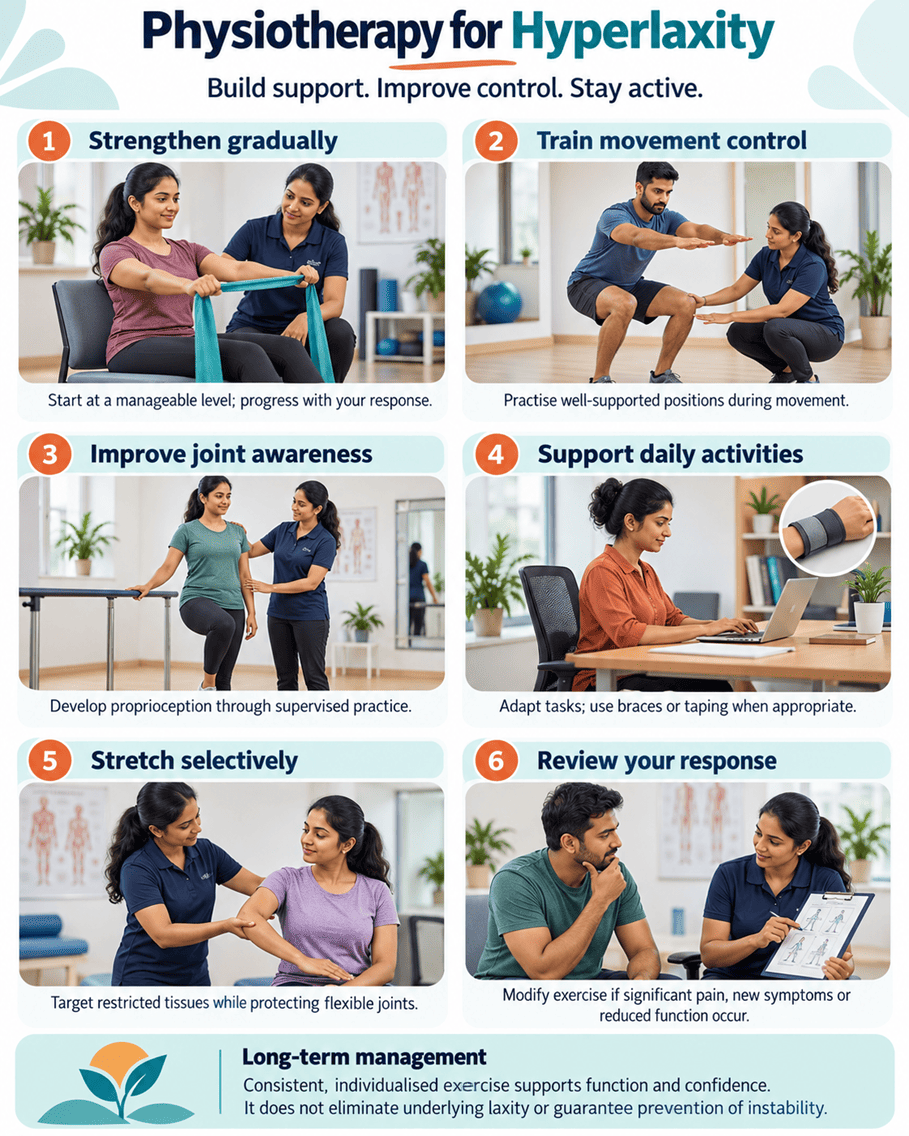
Physiotherapy aims to develop reliable joint support during movement. Strengthening the surrounding muscles improves their ability to stabilise hypermobile joints. Exercise should begin at a manageable level, with resistance, repetitions, and duration increased gradually according to the individual’s response.
Movement-control training helps individuals recognise and correct movements that place their joints in poorly supported positions. Proprioception—the ability to sense joint position and movement—is another important consideration. Supervised practice helps develop awareness and more consistent control.
Education connects these improvements to daily life. Advice on posture and task performance can help people manage activities more comfortably. Taping, braces, or splints may provide additional support where appropriate, alongside an individual exercise programme.
Stretching requires particular care. A person can have hypermobile joints and tight muscles at the same time, but repeatedly stretching already flexible joints may worsen instability. Any stretching should target genuinely restricted tissues while protecting the more mobile areas. Exercise that produces significant pain, new symptoms, or reduced function should be reviewed and modified.
Long-term management
Physiotherapy cannot guarantee the prevention of every episode of excessive joint movement or eliminate underlying laxity. Its value lies in improving muscular support, movement control, and everyday function. Consistent, individually appropriate exercise and professional guidance can help people manage symptoms and remain active with greater confidence.