Introduction
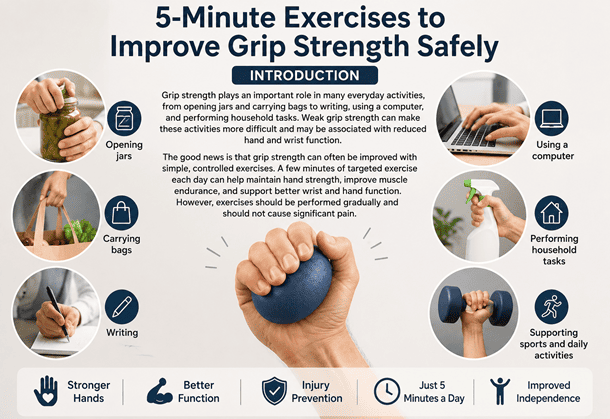
Grip strength plays an important role in many everyday activities, from opening jars and carrying bags to writing, using a computer, and performing household tasks. Weak grip strength can make these activities more difficult and may be associated with reduced hand and wrist function.
The good news is that grip strength can often be improved with simple, controlled exercises. A few minutes of targeted exercise each day can help maintain hand strength, improve muscle endurance, and support better wrist and hand function. However, exercises should be performed gradually and should not cause significant pain.
Why Is Grip Strength Important?
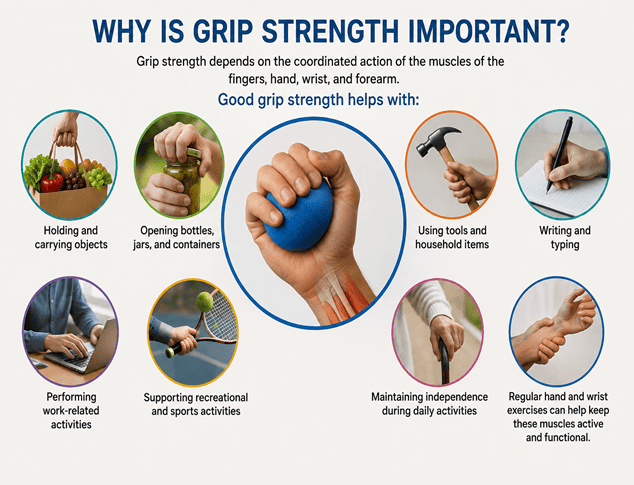
Grip strength depends on the coordinated action of the muscles of the fingers, hand, wrist, and forearm. Good grip strength helps with:
- Holding and carrying objects
- Opening bottles, jars, and containers
- Using tools and household items
- Writing and typing
- Performing work-related activities
- Supporting recreational and sports activities
- Maintaining independence during daily activities
Regular hand and wrist exercises can help keep these muscles active and functional.
A Simple 5-Minute Grip Strength Routine
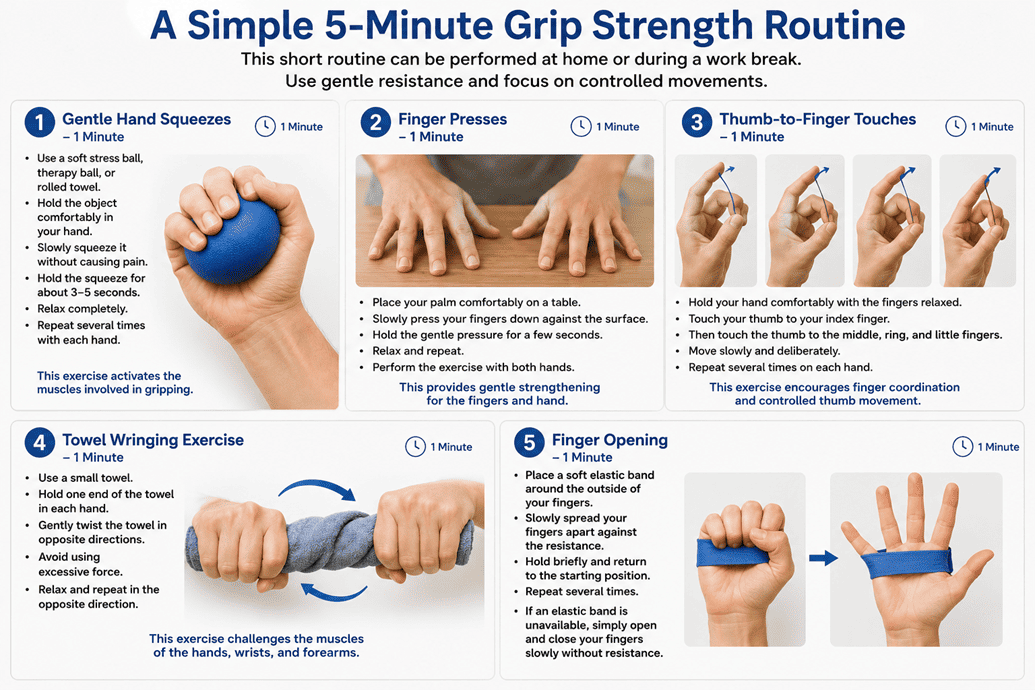
This short routine can be performed at home or during a work break. Use gentle resistance and focus on controlled movements.
- Gentle Hand Squeezes – 1 Minute
- Use a soft stress ball, therapy ball, or rolled towel.
- Hold the object comfortably in your hand.
- Slowly squeeze it without causing pain.
- Hold the squeeze for about 3–5 seconds.
- Relax completely.
- Repeat several times with each hand.
This exercise activates the muscles involved in gripping.
- Finger Presses – 1 Minute
- Place your palm comfortably on a table.
- Slowly press your fingers down against the surface.
- Hold the gentle pressure for a few seconds.
- Relax and repeat.
- Perform the exercise with both hands.
This provides gentle strengthening for the fingers and hand.
- Thumb-to-Finger Touches – 1 Minute
- Hold your hand comfortably with the fingers relaxed.
- Touch your thumb to your index finger.
- Then touch the thumb to the middle, ring, and little fingers.
- Move slowly and deliberately.
- Repeat several times on each hand.
This exercise encourages finger coordination and controlled thumb movement.
- Towel Wringing Exercise – 1 Minute
- Use a small towel.
- Hold one end of the towel in each hand.
- Gently twist the towel in opposite directions.
- Avoid using excessive force.
- Relax and repeat in the opposite direction.
This exercise challenges the muscles of the hands, wrists, and forearms.
- Finger Opening – 1 Minute
- Place a soft elastic band around the outside of your fingers.
- Slowly spread your fingers apart against the resistance.
- Hold briefly and return to the starting position.
- Repeat several times.
- If an elastic band is unavailable, simply open and close your fingers slowly without resistance.
How Often Should You Exercise?
For beginners, a short routine can be performed once a day. As strength and tolerance improve, exercises may be progressed gradually by increasing repetitions or using slightly greater resistance.
Consistency is more important than using heavy resistance. The goal is to improve strength without irritating the wrist, fingers, or surrounding tissues.
Safety Tips
Keep the exercises comfortable and controlled. Avoid forcing painful movements or squeezing objects as hard as possible.
Consider these precautions:
- Start with gentle resistance.
- Keep your wrist in a comfortable position.
- Avoid sudden or jerky movements.
- Take breaks if your hand becomes excessively tired.
- Stop an exercise if it causes sharp or increasing pain.
- Increase resistance gradually rather than suddenly.
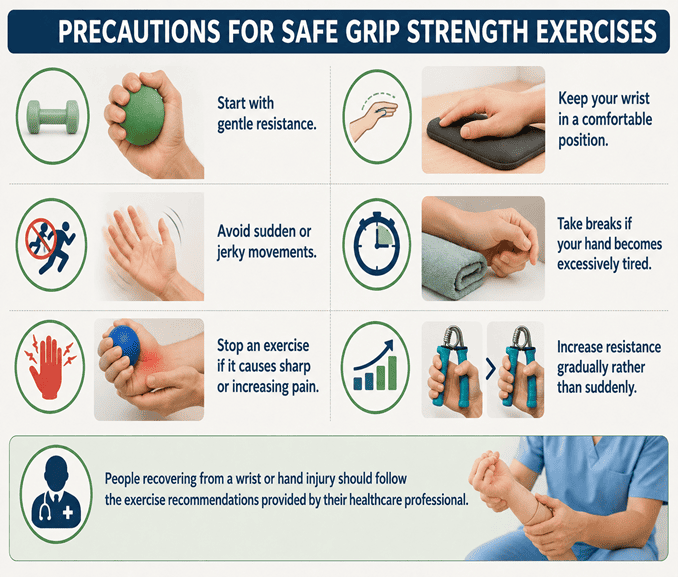
People recovering from a wrist or hand injury should follow the exercise recommendations provided by their healthcare professional.
When Should You Seek Professional Advice?
Grip weakness can sometimes be related to an underlying injury or medical condition. Consider consulting a physiotherapist or healthcare professional if weakness is persistent, worsening, or accompanied by significant pain, numbness, tingling, swelling, or difficulty using the hand.
A physiotherapist can assess hand and wrist movement, muscle strength, flexibility, coordination, and functional limitations and can develop an exercise program appropriate for the individual’s condition.
Conclusion
Improving grip strength does not always require complicated equipment or long workouts. A focused five-minute routine involving gentle squeezing, finger movements, towel exercises, and finger opening can provide a convenient way to keep the hands and wrists active.
The key is to exercise consistently, progress gradually, and respect pain or other warning signs. Small amounts of regular movement can support better hand function and make everyday activities easier.