
Many people think of sunlight as something that simply brightens the day — but for your spine, morning sunlight acts almost like a daily nutrient. The gentle rays that reach you in the early hours play a powerful role in bone health, muscle performance, mood stability, and long-term spinal protection.
Below is a clear and scientifically grounded explanation of why your spine truly loves morning sunlight.

Morning Sunlight Boosts Vitamin D — the Backbone of Bone Health:
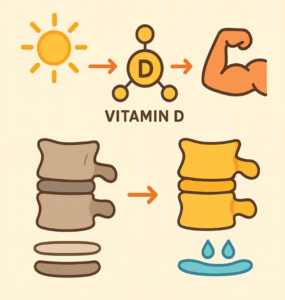
Vitamin D is essential for keeping your vertebrae strong and resilient. Although small amounts come from food, your body relies mainly on sunlight to produce it.
How Vitamin D Supports Your Spine:
- Enhances calcium absorption → keeps vertebrae dense and less prone to fractures or early degeneration.
- Strengthens intervertebral discs → helps maintain hydration and reduces wear-and-tear.
- Improves bone healing → important if you have had past injuries or micro-stresses from long sitting hours.
Morning sunlight is ideal because ultraviolet intensity is lower, which helps you get vitamin D without excessive skin exposure.
Muscle Function Depends on Vitamin D — Especially Core & Back Muscles:
Your spine is supported by a natural “muscle corset.” These deep stabilizing muscles (multifidus, erector spinae, transverse abdominis) depend heavily on vitamin D.
Why This Matters:
- Low vitamin D weakens postural and stabilizing muscles.
- Weak muscles force the spine to bear more load → causing stiffness, fatigue, and back pain.
- Adequate vitamin D improves muscle contraction, coordination, and endurance, letting your spine stay aligned through daily activities.
This is why many people with chronic back pain also show low vitamin D levels.

Better Mood & Stress Reduction = Less Back Tension:
Morning light exposure resets your circadian rhythm and boosts serotonin — a natural mood stabilizer.
How This Helps Your Spine:
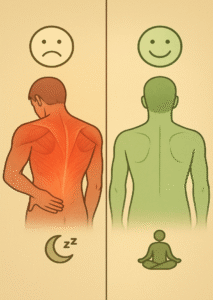
- Reduces stress-related muscle tightness.
- Improves sleep quality → allowing better overnight recovery of back and neck tissues.
- Decreases the risk of pain flare-ups triggered by fatigue or mental stress.
A relaxed body often means a relaxed spine.
Morning Sun Encourages Physical Activity:
Stepping outside into sunlight naturally makes you more alert and active. Even 10–15 minutes of walking in morning light:
- decreases stiffness,
- increases blood flow to spinal tissues,
- lubricates joints,
- and activates core muscles.
This combination helps protect your lumbar and cervical spine throughout the day.

Helps Reduce Inflammation:
Vitamin D acts as an anti-inflammatory hormone. When levels are adequate, it helps calm irritation around spinal joints, discs, and nerve pathways.
This is particularly valuable for:
- disc bulges,
- facet joint inflammation,
- muscular strain,
- and age-related degeneration.
Morning sunlight gives your body the building blocks needed to regulate this inflammation naturally.

How Much Morning Sunlight Do You Need?
- 10–20 minutes between 8 AM and 10 AM is usually enough for most people.
- Aim for sunlight on arms, face, or legs.
- People with darker skin may need slightly longer exposure.
(Always consider local climate and skin sensitivity.)

Who Benefits the Most?
- People with back or neck pain
- Office workers with long sitting hours
- Individuals with low energy or weak core muscles
- Older adults with reduced bone density
- People who stay mostly indoors
- Even children and teenagers benefit — their growing spines need strong vitamin D-supported bones and muscles.
Conclusion:
Your spine isn’t just a stack of bones — it is a living, dynamic structure supported by muscles, nerves, and joints. Morning sunlight fuels all of these systems. By improving vitamin D production, strengthening muscles, enhancing mood, reducing inflammation, and encouraging movement, morning sunlight becomes one of the simplest tools to keep your spine healthy.
A few minutes of early daylight each day can keep your back happier, stronger, and pain-free — naturally.