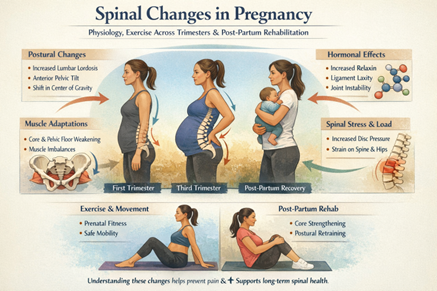
Pregnancy places unique physiological and biomechanical demands on the spine. As the body adapts to support a growing fetus, predictable changes occur in posture, muscle function, hormonal balance, and load distribution. Understanding these changes helps prevent pain and supports long-term spinal health.
PHYSIOLOGICAL & BIOMECHANICAL CHANGES
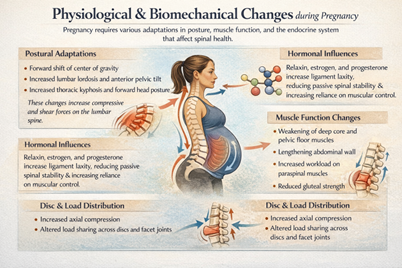
Postural Adaptations:
- Forward shift of center of gravity
- Increased lumbar lordosis and anterior pelvic tilt
- Increased thoracic kyphosis and forward head posture
These changes increase compressive and shear forces on the lumbar spine.
Hormonal Influences:
Relaxin, estrogen, and progesterone increase ligament laxity, reducing passive spinal stability and increasing reliance on muscular control.
Muscle Function Changes:
- Weakening of deep core and pelvic floor muscles
- Lengthening of abdominal wall
- Increased workload on paraspinal muscles
- Reduced gluteal strength
Disc & Load Distribution:
- Increased axial compression
- Altered load sharing across discs and facet joints
COMMON SPINAL SYMPTOMS
- Low back pain
- Pelvic girdle pain
- Sacroiliac joint discomfort
- Thoracic and neck stiffness
EXERCISE DURING PREGNANCY
General Principles:
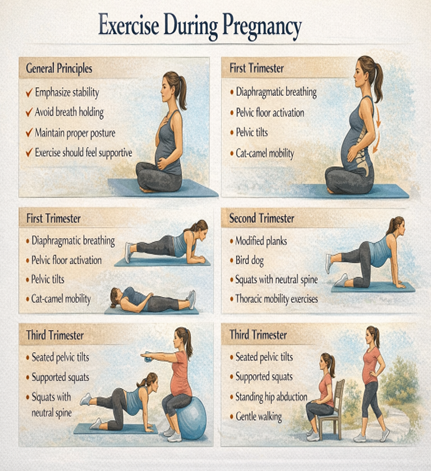
- Emphasize stability
- Avoid breath holding
- Maintain proper posture
- Exercise should feel supportive
First Trimester:
- Diaphragmatic breathing
- Pelvic floor activation
- Pelvic tilts
- Cat-camel mobility
Second Trimester:
- Modified planks
- Bird dog
- Squats with neutral spine
- Thoracic mobility exercises
Third Trimester:
- Seated pelvic tilts
- Supported squats
- Standing hip abduction
- Gentle walking
POST-PARTUM REHABILITATION
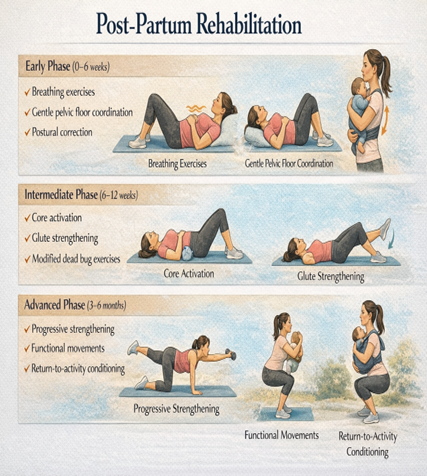
Early Phase (0–6 weeks)
- Breathing exercises
- Gentle pelvic floor coordination
- Postural correction
Intermediate Phase (6–12 weeks):
- Core activation
- Glute strengthening
- Modified dead bug exercises
Advanced Phase (3–6 months):
- Progressive strengthening
- Functional movements
- Return-to-activity conditioning
KEY TAKEAWAY
Spinal changes during pregnancy are adaptive and reversible. Regular, guided exercise and post-partum rehabilitation are essential for protecting spine health.