
Introduction
The lumbar spine is a critical structure responsible for maintaining posture, facilitating movement, and bearing mechanical loads during daily activities. One frequently overlooked factor in spinal health is toileting posture. Two major types of toilets are used worldwide: traditional squatting toilets and Western-style sitting toilets. While sitting toilets are prevalent in urban and modern settings, squatting toilets remain common in many Asian and African countries. The posture adopted during toileting can influence lumbar biomechanics, potentially affecting the development or exacerbation of spinal conditions, as well as recovery in pre- and post-surgical patients. Understanding these impacts is essential for clinical guidance, ergonomic recommendations, and spinal health promotion.
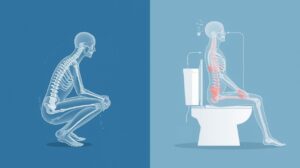
Biomechanics of Squatting vs Sitting
Squatting toilets require deep hip and knee flexion, typically around 120–130 degrees, promoting pelvic tilt and reducing lumbar lordosis. This posture facilitates bowel evacuation while decreasing stress on lumbar intervertebral discs. In contrast, sitting toilets maintain hip flexion around 90 degrees, keeping the lumbar spine in a more lordotic or slightly kyphotic position. This posture increases intradiscal pressure, particularly at the L4–L5 and L5–S1 levels, which may contribute to cumulative lumbar load and exacerbate pre-existing spinal disorders when used frequently.
Impact on Specific Spine Conditions
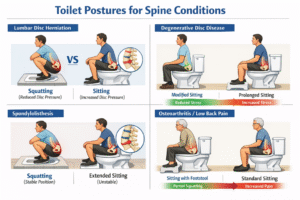
- Lumbar Disc Herniation: Squatting reduces lumbar lordosis and intradiscal pressure, potentially decreasing pain during defecation. Sitting toilets may worsen symptoms in patients with acute herniation due to increased disc load. Recommendation: Squatting is preferred if the patient has sufficient hip mobility and no severe pain.
- Degenerative Disc Disease: Prolonged sitting posture increases stress on degenerated discs. Squatting or partial squatting (using a footstool with sitting toilets) reduces lumbar load. Recommendation: Squatting or modified sitting with foot support is beneficial.
- Spondylolisthesis: Forward slipping of vertebrae is aggravated by lumbar extension. Squatting reduces extension, making it generally safer than prolonged sitting. Recommendation: Squatting preferred; avoid prolonged sitting in fixed positions.
- Osteoarthritis of the Spine or Hips: Deep squatting may be difficult due to joint stiffness or pain. Sitting toilets are safer for mobility-challenged individuals. Recommendation: Sitting toilets with footstool support for partial squatting.
- Chronic Low Back Pain: Postures that reduce lumbar disc pressure and promote natural pelvic tilt relieve pain. Squatting facilitates this, while prolonged sitting may exacerbate pain. Recommendation: Squatting or modified sitting posture.
Toileting Posture in Pre- and Post-Surgical Spine Conditions
- Pre-Surgery: Patients with lumbar disc herniation, spondylolisthesis, or degenerative changes often experience pain with sitting toilets due to increased intradiscal pressure. Squatting toilets or partial squatting posture may help reduce lumbar load and discomfort while awaiting surgery.
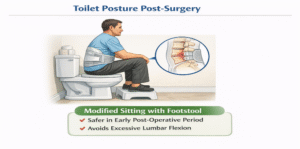
- Post-Surgery: In the early post-operative period (e.g., after discectomy, fusion, or decompression), mobility is limited, and bending or squatting may be unsafe. Sitting toilets are safer initially, preferably with a small footstool to slightly mimic a squatting position without excessive lumbar flexion. As healing progresses, partial or full squatting can be gradually reintroduced, depending on surgical guidance and patient comfort.
Functional and Ergonomic Considerations
While squatting is biomechanically advantageous for lumbar spine health, it may not be feasible for the elderly, individuals with hip or knee stiffness, or early post-operative patients. For sitting toilets, using a small footstool to elevate the feet can simulate a partial squat, reducing lumbar lordosis and intradiscal pressure. Patients should also be advised on core strengthening, flexibility exercises, and safe bending techniques during toileting to maintain spinal health.
Conclusion
Toileting posture significantly influences lumbar spine biomechanics and health. Traditional squatting toilets generally reduce lumbar stress and facilitate bowel movement, making them suitable for individuals with lumbar disc issues, spondylolisthesis, and chronic low back pain. Western sitting toilets are safer for elderly patients, those with osteoarthritis, or early post-operative spine patients, especially when combined with footstool support to mimic partial squatting. Awareness of toilet posture, individualized recommendations based on spine condition, and ergonomic adaptations can help preserve spinal integrity and prevent exacerbation of pain in daily life.